A Pause Before You Forward It
A pause before you forward it helps you decide whether a message belongs in the chat, needs a caveat or should stay unshared until its origin is clearer.
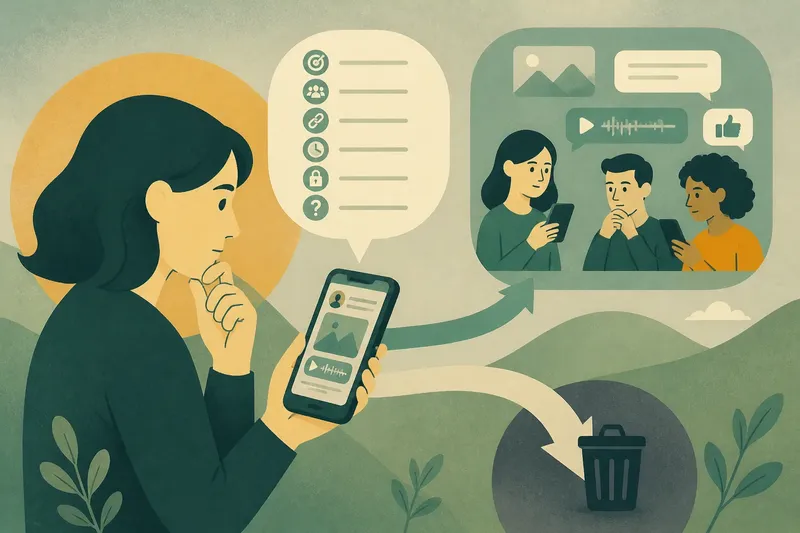
The common mistake is treating forwarding as a harmless tap. A message can arrive in a family chat, a work group or a neighbourhood thread with its own caption already attached; passing it on makes that caption part of your contribution. A pause before you forward it helps you decide whether the item belongs in the chat, needs a caveat or should stay unshared.
Choose what you are actually passing along
Start with the form of the item: a link, screenshot, voice note, forwarded message or short clip. Those are different things to pass on. A screenshot may preserve a visible post, while a link lets the next reader inspect a page that could change or disappear.
Then name the practical reason for sharing. Is it a reminder, a request for help, a warning or simply something that caught your attention? If you cannot say what recipients are meant to do with it, forwarding may add noise without adding anything useful.
For a concrete decision, use this small check before sending:
- Purpose: If you can state a useful reason for sharing, include that reason in your message; if you cannot, leave the item where it is.
- Destination: If the recipients can act on or understand the item, send it to that group; if not, choose a more relevant person or chat, or do not forward it.
- Format: If a direct link opens for the recipients, use it; if access is restricted, share an accessible excerpt with its source clearly named, or explain that you cannot provide a usable copy.
- Timing: If the message is still useful now, pass it on; if its moment has passed, add that context or keep it out of the chat.
- Personal details: If the item exposes someone’s address, phone number or private conversation, remove the details only if doing so preserves the point; otherwise do not circulate it.
- Uncertainty: If you can describe what remains unclear in a short caveat, add it; if the uncertainty makes the item misleading or risky to pass on, hold it back.
Let the message travel with its limits
A forwarded item often loses the small details that help a reader judge how to use it. The original may be intended for one location, one group or a particular moment. A warning about a road closure, for instance, is less useful when it reaches someone who cannot tell which route or date it concerns.
Keep the relevant limits in your own note. Say who the information is for, when it applies, or what recipients should check before acting. If you are passing on a personal request, ask permission when the details are not already meant for a wider audience. Convenience is not a particularly compelling privacy policy.
Imagine you receive a message asking neighbours to leave a parcel with a named resident while the sender is away. The message includes that resident’s full address and says the arrangement is for one afternoon. You could ask the sender whether the neighbours’ group is an intended audience, then remove the address from the group post and direct interested people to contact the sender privately. The observable result is a request people can respond to without publishing someone’s location.
Keep your wording separate from the item
Your note can explain why you are sharing without pretending to be part of the original message. Use a clear lead-in such as “Passing this on because it concerns the library opening hours” or “I have not confirmed whether this applies to our street”. That tells readers what you are adding and what you are not claiming.
Avoid turning a tentative message into an instruction. “Could someone check whether this applies here?” leaves room for uncertainty. “Everyone needs to do this now” does not, and may prompt people to act before they know what the message concerns.
What should you do before forwarding?
Should I forward a message that might be useful?
Share it when you can identify who may benefit and what they should do with it. If either part is unclear, ask the sender for context or keep the message in its original chat.
What if I cannot open the link?
Do not imply that you have checked a page you cannot access. Ask the sender for an accessible version or describe the limitation plainly, then decide whether the remaining information is useful enough to share.
Can I forward a screenshot instead of a link?
Yes, if the screenshot is the most usable form and it does not expose private details unnecessarily. Include where it came from and avoid cropping information recipients need to understand its purpose.
How do I handle a message with someone’s personal details?
Ask whether the person intended those details to reach the proposed audience. Share a version with unnecessary details removed only if the remaining message still makes sense; otherwise, do not forward it.
Stop when forwarding would create more work
It is not worth composing a polished explanation for every item that passes through a chat. Nor is a forwarded message automatically a task for you to solve. If you cannot make the item useful without exposing someone’s details, confusing its audience or pretending to know more than you do, leave it unshared.
A pause before you forward it is a small act of audience care. The most useful message may be the one sent to the right people with its limits intact; sometimes the better contribution is simply not adding another notification.