Cropping Changes a Photograph’s Frame, Not Its History
Cropping changes a photograph’s frame and emphasis, but not its history. Learn how framing directs attention and how to describe a crop without overstating it.
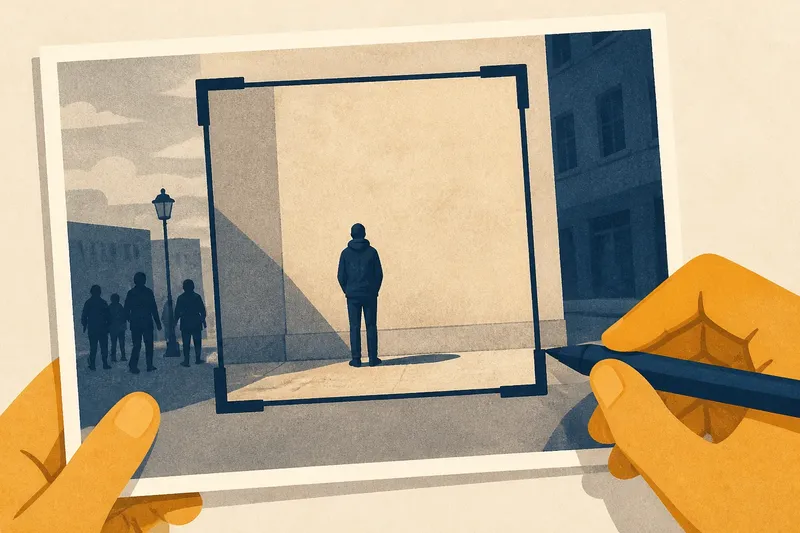
The common mistake with a cropped photograph is to treat a tight frame as proof of what happened outside it. A crop can direct attention, but it cannot establish the scene’s history. That matters when a striking detail is used to make a larger claim.
To assess cropping, focus on the choices made inside the frame: what has been made prominent, how the image guides the eye, and whether the subject has been isolated from other visible details. This is different from tracing the image to its source or trying to reconstruct the event. The frame itself is a piece of visual rhetoric, even when the crop was made simply to fit a layout.
Read the crop as a choice about emphasis
Every photograph has boundaries, and a crop moves them. A close frame can make a face, object or gesture dominate. A broad frame can give competing details more room. Neither is automatically more truthful. The question is how the chosen boundaries steer interpretation.
Look first at visual hierarchy. What catches your eye immediately? Is the subject centred, enlarged or placed against empty space? Do strong lines, contrast or colour pull attention towards one detail and away from another? These features may be ordinary composition, but they also affect which part of the image feels important.
Then notice what the crop does to relationships within the scene. A person may appear alone because nearby people are outside the frame. An object may seem to belong to one person because the crop removes other hands or surrounding activity. Those are effects of presentation, not proof of the photographer’s intention or of what happened beyond the visible edges.
Say you encounter a square post showing a lone figure against a blank wall, with the caption “No one came to help.” The visible composition emphasises isolation. It does not establish whether anyone was outside the frame, how long the moment lasted or what happened before the shutter clicked. The sound reading is narrower: the post presents one figure in a tightly framed moment and attaches a claim about the larger situation.
Separate visual effect from inferred meaning
A crop can influence mood without changing the pixels that remain. Removing a horizon may make a scene feel enclosed. Trimming a crowd down to a few faces may make those people appear more prominent. These effects are worth describing precisely, but they do not settle why the image was cropped or whether its caption is accurate.
Use language that distinguishes observation from interpretation. “The frame centres a person and excludes the street around them” describes composition. “The editor wanted to hide the crowd” assigns a motive that the crop alone cannot establish. The first can be assessed from the image; the second needs other evidence.
It also helps to separate the photograph’s apparent emotional tone from the claim attached to it. A close-up can feel urgent or intimate. That feeling is part of how the image is presented, not independent confirmation of a caption. Strong visual emphasis is persuasive precisely because it can make an inference feel like an observation.
Notice how framing changes what feels important
Composition offers several details to inspect without turning the exercise into a hunt for hidden proof:
- Subject size: A large subject commands attention; ask whether that prominence is being treated as evidence of importance.
- Position: A subject at the centre can feel like the scene’s sole focus; check whether the caption makes a similarly narrow claim.
- Negative space: Empty areas can make a person or object feel isolated; do not infer that the wider setting was empty.
- Cut-off objects: An edge that slices through a sign, limb or vehicle can create tension; the partial view does not show what lies beyond it.
- Contrast and colour: A bright or high-contrast detail may attract the eye; attention is not the same as proof.
- Visual balance: A crop may remove elements that would balance or complicate the composition; describe the resulting emphasis without assigning motive.
These observations are useful when a post relies on a photograph to make a point through mood or composition. They are less useful if treated as a code with one fixed meaning. A dark corner does not always signal menace; an isolated subject does not always mean abandonment. Images are persuasive, but they are not crossword puzzles with one answer hidden in the border.
Why can a crop feel more convincing than it is?
Does a dramatic crop prove deliberate manipulation?
No. A dramatic effect describes how the image reads, not why someone selected that frame. Motive requires evidence beyond the composition.
Can composition tell me what happened outside the frame?
No. It can show that the image directs attention towards certain details and away from others. It cannot establish what was present beyond its edges.
How should I describe a persuasive crop?
Name the visible choices: the subject’s placement, the tight framing or the contrast that draws attention. Keep claims about intent, event or meaning separate unless other evidence supports them.
Is a carefully composed image necessarily deceptive?
No. Composition is part of making photographs, and a deliberate arrangement can be entirely ordinary. The useful question is whether the image’s visual emphasis is being asked to support a claim it cannot establish on its own.
What is not worth the effort
There is little value in assigning a hidden motive to every tight frame or treating each compositional choice as a clue. Nor does scrutinising the crop’s geometry reveal the photographer’s intentions. Describe the visible effect, then stop where the evidence stops.
For a cropped photograph, the most useful judgement is often modest: the frame makes one feature prominent and limits attention to what remains inside it. That description can help a reader recognise how an image persuades without pretending that composition alone explains the event behind it.