The Word That Quietly Turns a Description into a Verdict
Learn to spot the loaded word in a sentence and rewrite it neutrally, keeping observable details while making the judgement visible and contestable.
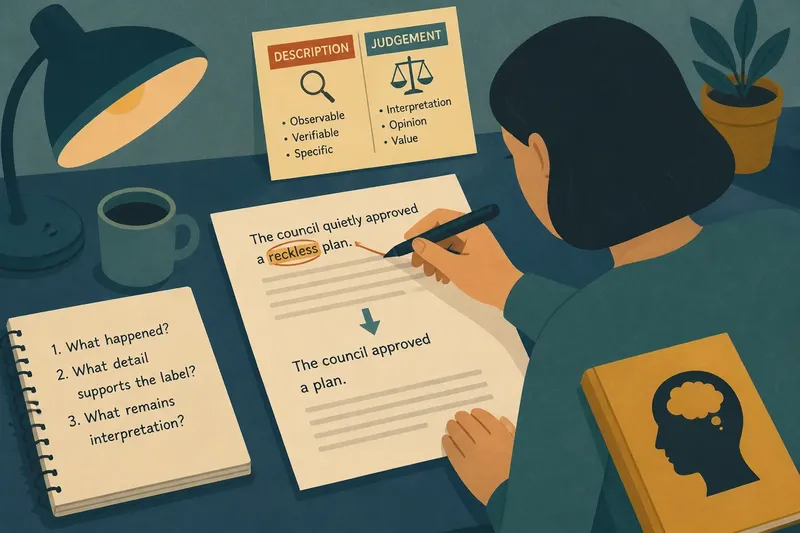
The most common mistake in reading a heated sentence is to accept its adjective as part of the scene. Calling a meeting “chaotic” may sound like a description, but it can turn several observable events into a verdict before the reader has considered them. That small shortcut costs clarity: you may repeat a judgement as though it were something anyone could have witnessed.
To spot the shift, and to rewrite loaded wording neutrally, separate what the sentence lets a reader observe from what its author wants the reader to conclude. This is not a demand to remove every opinion. It is a way to tell description and judgement apart, then decide what each is doing.
Start with the sentence that catches your attention
Choose one sentence, not an entire article. Look for wording that makes a person, action, object or event seem admirable, foolish, threatening, wasteful or suspicious. The word may be an adjective, such as “reckless”; a noun, such as “handout”; or a verb, such as “boasted”. Even a seemingly plain word can carry an evaluation in its setting.
Read the sentence once for its apparent meaning. Then ask what impression remains if you temporarily remove the word that gives it force. “The council approved a reckless plan” becomes “The council approved a plan.” The second version is thinner, but it reveals a useful question: what observable detail is “reckless” standing in for?
Do not assume the most dramatic word is the only one doing the work. “The council quietly approved a reckless plan” contains two possible cues. “Quietly” could describe the manner or setting of the approval, or imply that the council wanted to conceal it. Context decides whether it reports an observable detail or suggests a motive.
Mark the wording that carries a judgement
Underline the candidate word and test it with a simple question: could two reasonable observers agree on what happened but disagree about this description? If so, the word probably includes evaluation. “The speaker interrupted twice” describes an event that can be checked against a recording. “The speaker was rude” interprets the conduct.
Words often reveal their lean through the action they choose to name. “Said” is relatively plain. “Admitted” suggests that the statement concedes something against the speaker’s interest. “Insisted” can imply stubbornness; “explained” can make the same act sound reasonable. Such verbs may be accurate in context, but they do more than report speech.
Watch for nouns that package a judgement as a thing. “A proposal” identifies an item under discussion. “A giveaway” frames it as an undeserved benefit. “A rescue” casts the same intervention as welcome. The grammar can make these labels feel settled, even when the evaluative choice is still open to dispute.
Then check modifiers and comparisons. “Only”, “even”, “predictably” and “so-called” can tilt a sentence without supplying much visible detail. “The committee approved only the smaller request” might imply that the request was disappointingly limited. “The committee approved the smaller request” leaves that judgement with the reader.
Find the observable detail beneath the verdict
Ask what someone could see, hear, count from a stated record, or quote directly. Keep the answer narrow. “Reckless” might refer to a plan’s timing, its missing safeguards, its expected effects, or simply the writer’s dislike of it. Those are different claims, and the word alone does not tell you which one is intended.
Try three prompts:
- What happened? Identify an action or event, such as a vote, a delayed reply or a change to a document.
- What detail supports the label? Look for a stated feature, such as a missed deadline, a recorded interruption or a rule that was not followed.
- What remains interpretation? Name the implied motive, character or value judgement that the detail cannot establish by itself.
For example, a sentence saying that a manager “dodged questions” may refer to a person changing the subject, declining to answer, or giving a response the writer considered inadequate. Those are not interchangeable. If the report does not specify what happened, do not fill the gap with the most damning possibility.
Some evaluative terms have a defined meaning in a particular setting. “Late” may be a judgement in ordinary conversation, while a schedule can make it a checkable description. “Unsafe” may refer to a stated standard, or be an unsubstantiated warning. Look for the criteria being used rather than deciding from the word alone.
Rewrite the sentence without losing useful information
Keep the original sentence beside your draft. Replace the loaded word with the detail that supports it, if the sentence supplies one. If no detail appears, describe only what is stated and make the missing basis apparent. Neutral wording should be more precise, not merely less colourful.
Imagine a local notice says, “The organiser shamefully abandoned the evening event.” You know from the notice that the organiser cancelled it that afternoon and gave no reason there. A neutral rewrite could be: “The organiser cancelled the evening event that afternoon; the notice did not give a reason.” It preserves the cancellation and the information available, while leaving “shamefully” out because the notice supplies no basis for that judgement.
If the sentence includes a concrete detail, retain it. “The organiser shamefully cancelled the event after the venue withdrew access” could become “The organiser cancelled the event after the venue withdrew access.” The revised sentence does not decide whether the cancellation was justified. It also does not hide the stated sequence of events.
Use attribution when the judgement itself matters. “The residents’ group called the decision ‘reckless’” reports who made the evaluation. If the wording is not a direct quotation, paraphrase with care: “The residents’ group criticised the decision, saying the timetable left no time for review.” The second version gives the reader the stated reason rather than borrowing the group’s label as the writer’s own.
Do not swap one loaded word for a more respectable-sounding one. “Reckless” becoming “questionable” may soften the tone without clarifying anything. Ask whether the replacement names an action, a record, a stated rule or a speaker’s view. If it does none of those, it is probably another verdict in a cleaner coat.
Decide what to do with the judgement
Once you have a neutral version, compare it with the original. The difference helps you decide whether the evaluative word is supported, attributed or doing unsupported persuasive work. The aim is not to ban strong language. It is to keep the strength of the wording proportionate to the details offered.
Use these options:
- Retain the judgement with its basis. If the sentence gives relevant details, state them plainly. Readers can assess the evaluation rather than relying on its label.
- Attribute the judgement. When a source’s opinion is newsworthy, identify the person or group holding it and distinguish their view from the sentence’s factual description.
- Remove the judgement. If it adds heat but no information, the neutral wording may be more useful on its own.
- Mark the uncertainty. If the details do not settle the matter, say what is known and what is not established. Do not turn a guess about motive into a description of conduct.
What is not worth the effort is treating every ordinary adjective as a hidden plot. Some words are simply efficient. A useful check is whether the wording changes the reader’s view of a person or event without adding a detail that can be examined.
How can you tell whether a word is loaded?
Ask whether two observers could agree on the event yet disagree about the word. If they could, the term likely includes judgement. Then look for the observable detail or stated standard that would support using it.
Does neutral wording mean removing every opinion?
No. An opinion can be relevant when it is attributed to the person or group expressing it. Neutral rewriting makes the ownership of that view clear and avoids presenting it as an uncontested feature of the event.
What if the sentence gives no supporting detail?
Keep to what it actually states, and do not invent a reason for the label. You can note that the sentence offers no basis for its evaluation, or seek a fuller account before repeating the claim.
Can a factual word still feel persuasive?
Yes. A word can refer to something checkable and still carry associations that shape a reader’s reaction. Consider its context, the alternatives available and whether the sentence makes its meaning clear.
Make the wording carry only what it can support
Practise on one sentence at a time. Circle the evaluative word, write down the event or detail underneath it, and draft a version that keeps that detail while removing any unsupported implication. Then read both sentences aloud. If the neutral version changes the facts, restore what the original actually says; if it only loses a nudge towards approval or blame, the nudge was the point.
That small exercise is a reliable way to read loaded wording without treating every strong phrase as either truth or trickery. The word that turns description into a verdict is not always a flaw. It is a reason to ask who is making the judgement, what supports it, and whether the sentence has shown enough for you to make it your own.